Key Takeaways
- The report should identify what was tested and under which conditions.
- Facts and professional judgment should be separated.
- Marked areas need supporting route and test evidence.
- Repair and restoration exclusions belong in the next written scope.
Core Diagnostic Details
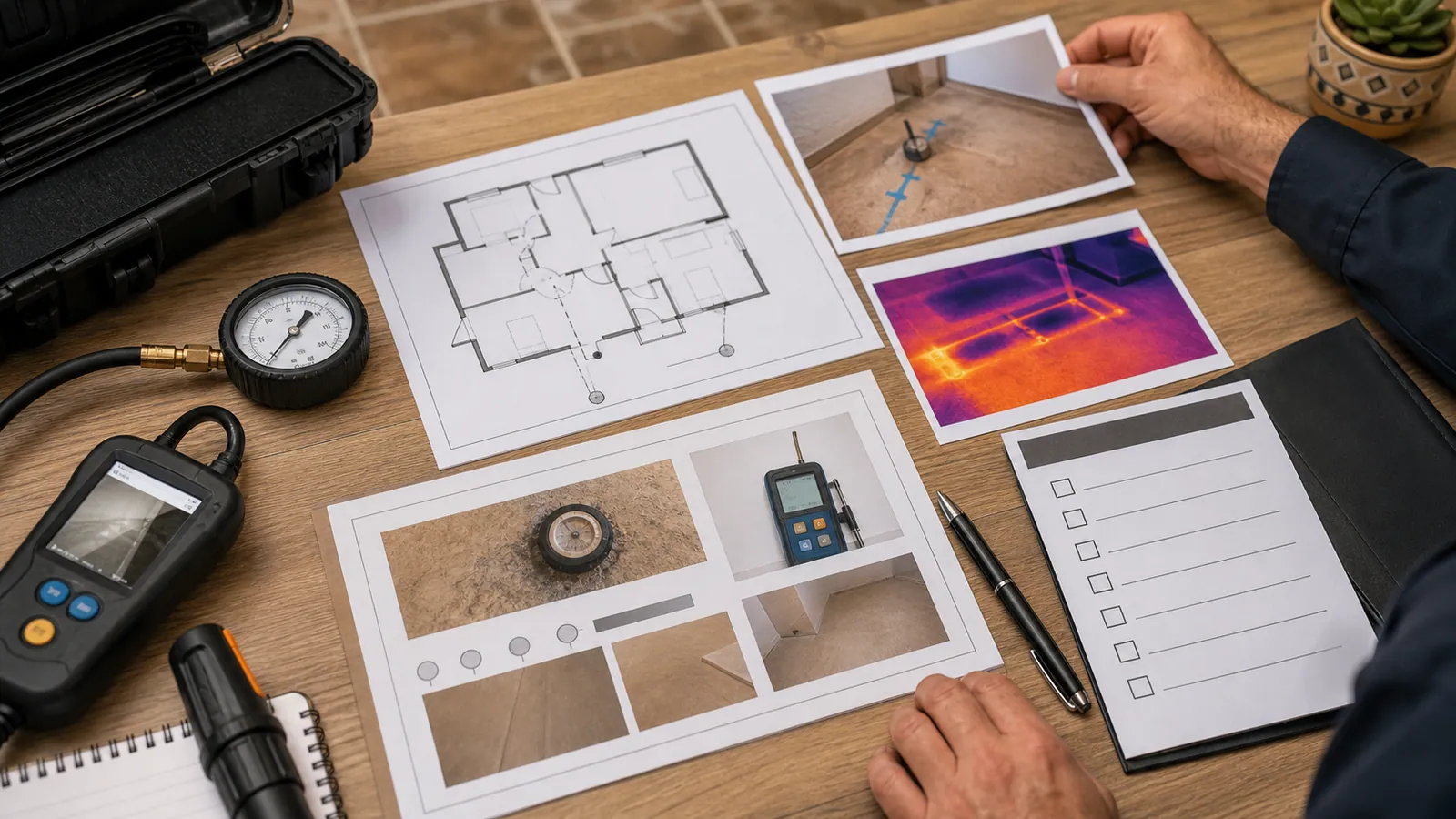
The report should identify the property, date, symptoms, meter observations, visible checks, isolated systems, test method, starting and ending readings, test duration, and equipment used.
Photographs of gauges, meter displays, moisture, thermal patterns, and marked routes make the record easier to understand.
- Property and system tested
- Fixture and exterior sources checked
- Pressure readings and duration
- Likely route and suspected area
- Limitations and unresolved questions
Look for Careful Language
A report can state that a system lost pressure and that evidence is strongest in a defined area. It should not turn uncertain tool readings into a guarantee.
If multiple causes remain possible, those alternatives should be named along with the recommended next step.
| Clear wording | Weak wording |
|---|---|
| Hot system lost pressure during documented test | There is definitely a leak somewhere |
| Strongest acoustic response near traced branch | Machine found exact break |
| Tile access may be required for repair | No damage guaranteed |
| Restoration excluded from detection scope | Everything will be handled |
How the Report Is Used
The homeowner can use it to compare repair proposals, communicate with an insurer, and preserve a record of readings and marked locations.
A detection report is not a coverage decision, engineering opinion, or guarantee of concealed pipe condition unless qualified professionals expressly provide those services.
Separate Recorded Evidence From the Technician’s Interpretation
A strong report distinguishes observations from conclusions. Meter movement, gauge readings, test duration, valve positions, thermal temperatures, moisture readings, acoustic comparison points, and photographs are recorded evidence. Statements such as “the hot system is losing pressure” or “the strongest combined evidence is near the kitchen branch” are interpretations that should connect directly to those records.
The language should reflect confidence. An isolated system can be confirmed to lose pressure under stated conditions, while the concealed break is usually a suspected area until exposed. Avoid reports that replace measurements with phrases such as “machine found leak” or guarantee an exact opening. If an alternative source remains possible, the report should name it and state the next test or field condition needed to resolve it.
The report should be dated and identify the property, technician or company, and version when findings are revised. Mark whether photographs and floor sketches correspond to the same visit. If a repair contractor performs additional testing that changes the suspected area, request an updated written record so the final access decision is not based on conflicting verbal directions.
Use the Detection Report to Compare Repair Proposals
Give each bidder the same report and ask the contractor to show how the proposed repair responds to the tested system, estimated route, affected fixtures, and access limitations. A direct-repair proposal should identify the expected floor opening, pipe material, connection method, testing, backfill, concrete, and flooring responsibility. A reroute proposal should show endpoints, new path, sizing, insulation, support, penetrations, valves, and finish openings.
Keep detection and repair claims separate from insurance or structural decisions. A plumbing report can document water-line evidence and resulting visible conditions, but it is not automatically a coverage determination, mold clearance, or engineering opinion. Save the signed report, photographs, annotated plan, invoice, repair proposal, permit record, and final pressure test together so later providers can understand the complete event.
- Require readings, conditions, boundaries, and test duration.
- Look for a marked route and confidence area, not only a verbal location.
- Compare bids against the same documented evidence.
- Preserve detection and repair records after closeout.
Related Reading and Services
Use these supporting resources to move from the current question to the next useful diagnostic or repair decision.
- Understand the tests behind the reportFollow confirmation, isolation, pressure testing, tracing, locating, and documentation in order.
- Compare the report with the repair estimateMake sure access, plumbing, testing, restoration, permit, warranty, and exclusions align.
- Use evidence to compare repair methodsConnect pipe history and locating confidence with direct access or a planned bypass route.
- Documented slab leak detectionReview the Tucson service scope for testing and written findings before invasive work.
Frequently Asked Questions
Should the report include a repair price?
It may, but diagnosis and repair scopes should be distinguishable. The estimate should list access and restoration assumptions.
Does an insurer require a report?
Requirements vary by insurer and claim. Ask what documentation is needed before work removes evidence.
Should exact pressure numbers be listed?
Yes, when pressure testing is part of the diagnosis, along with method, duration, and relevant conditions.
What if the provider gives only a verbal result?
Ask for a written summary before approving invasive work, especially when the result affects insurance or competing repair options.