Key Takeaways
- Spot repair reaches one confirmed failure through the floor.
- Rerouting abandons the failed run and creates a new path.
- Flooring, pipe history, route length, and restoration can change the total impact.
- Neither method is automatically best for every home.
When Spot Repair Fits
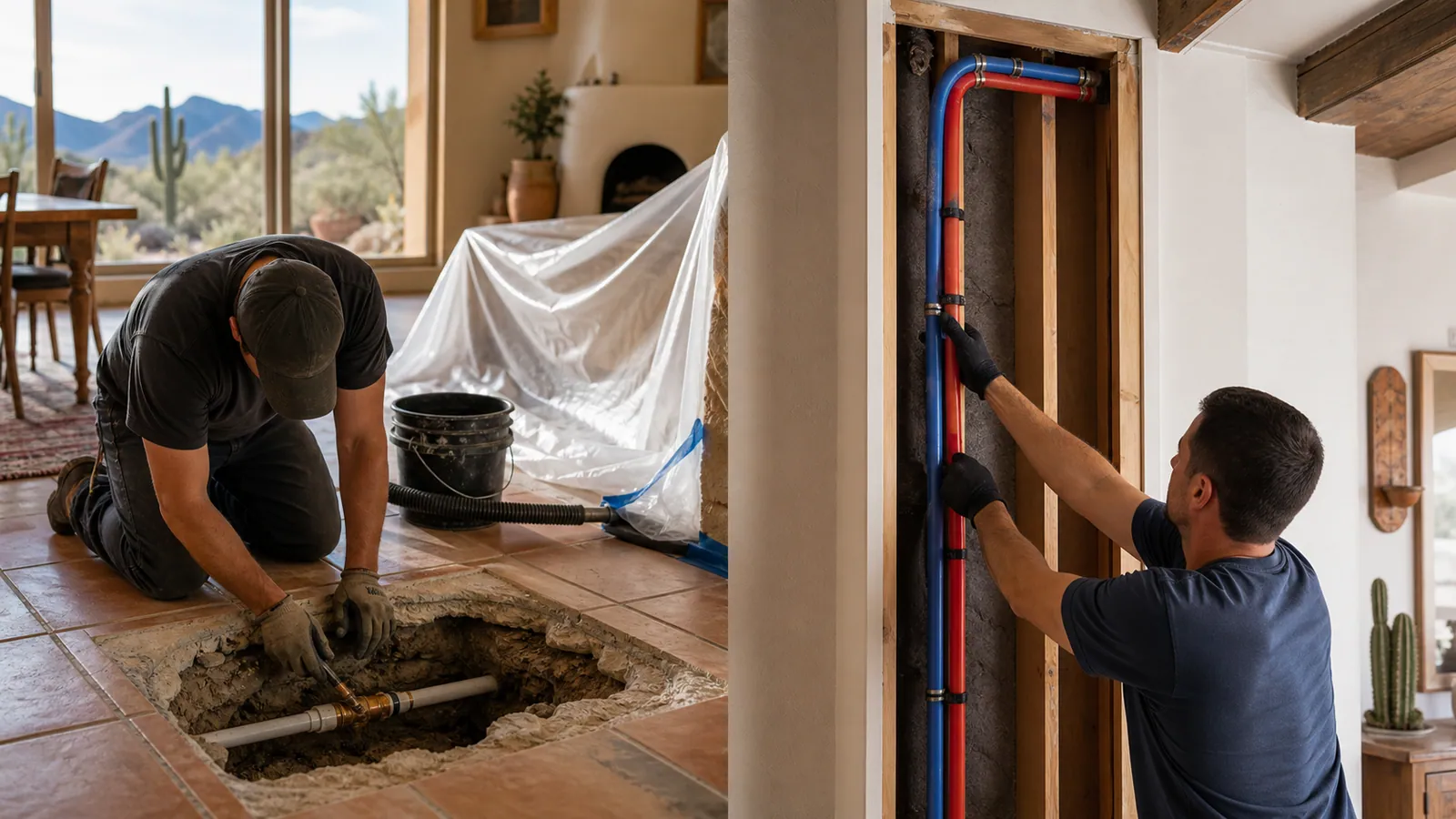
Direct repair can be appropriate when testing identifies one accessible failure, surrounding pipe appears serviceable, and a localized floor opening is practical. The failed section is exposed, replaced, tested, and the access is closed according to scope.
Its apparent simplicity can be offset by expensive tile, stone, cabinets, dust control, concrete work, and surface restoration.
When Rerouting Fits
Rerouting disconnects the failed under-slab run and installs a new code-compliant path through walls, ceilings, a garage, attic, exterior chase, or another route. It can preserve flooring and avoid returning to a questionable branch.
It may still require drywall openings, insulation, fire stopping, fixture reconnections, longer pipe runs, and careful protection from Tucson attic heat.
| Factor | Spot repair | Rerouting |
|---|---|---|
| Primary access | Floor and concrete | Walls, ceiling, garage or attic |
| Pipe addressed | One failed section | Entire bypassed run |
| Finish impact | Flooring | Drywall and route finishes |
| Best fit | Isolated accessible failure | Inaccessible or unreliable run |
Compare Complete Scopes
Ask both proposals to include diagnosis, plumbing, shutoff time, testing, permits, concrete closure, drywall, flooring, painting, cleanup, and warranty terms.
A lower plumbing line item can become the higher project cost when restoration is excluded. Compare equivalent scopes rather than headline prices.
Compare the Complete Scope, Not Only the Pipe Work
A spot repair price may cover detection, floor protection, finish removal, concrete cutting, excavation, pipe replacement, pressure testing, backfill, and concrete closure—or only the plumbing connection. A reroute price may include new pipe and reconnection but exclude drywall, paint, insulation, fire stopping, cabinets, permits, or access equipment. Put both options into the same scope categories before comparing totals.
Finish value can change the decision. Opening common tile with spare material is different from cutting continuous wood, custom stone, a shower assembly, or cabinetry. Rerouting may preserve the floor but affect several walls and ceilings. Ask for the expected access areas, restoration responsibility, water shutoff time, inspection sequence, and change-order conditions for both methods. A lower plumbing figure is not necessarily the lower completed-project cost.
Use Pipe History and Route Condition to Judge Future Risk
Direct repair addresses the exposed failed section. It can be appropriate when evidence supports one isolated defect and the surrounding line has no pattern of repeated problems. Ask what pipe material is present, where earlier repairs occurred, whether nearby pipe shows abrasion or corrosion, and how the new section will connect to existing material. No inspection of one opening can guarantee the condition of every concealed foot.
Rerouting removes a defined run from service and places a replacement on a new path. It may be more defensible after repeated branch failures, inaccessible flooring, an unreliable under-slab route, or a clear path through walls, garage, ceiling, attic, or exterior chase. The design must still address sizing, heat exposure, support, insulation, penetrations, fixture delivery, and future access. The right decision is specific to the branch—not a universal preference for one method.
When both options remain reasonable, ask for a side-by-side drawing and completed-project price. Mark the pipe each method addresses, every finish opening, the expected shutdown, and the warranty boundary. This makes the tradeoff visible and keeps the decision focused on confirmed plumbing conditions instead of fear of concrete work or an assumption that a longer reroute is automatically more durable.
- Compare plumbing, access, restoration, permit, and cleanup together.
- Review the failure history of the complete branch.
- Map every fixture and endpoint before rerouting.
- Require post-repair pressure and fixture testing.
Related Reading and Services
Use these supporting resources to move from the current question to the next useful diagnostic or repair decision.
- Learn when direct under-slab repair fitsEvaluate locating confidence, floor access, surrounding pipe, connection method, and restoration.
- See how a single water line can be reroutedUnderstand endpoints, new routing, abandoned pipe, fixture reconnection, and testing.
- Compare Tucson slab-leak cost factorsAccount for diagnosis, access, plumbing, permits, finishes, urgent work, and separate trades.
- Tucson slab leak repair optionsReview direct repair, rerouting, and partial-repipe service considerations after diagnosis.
Frequently Asked Questions
Is rerouting always more expensive?
No. Route complexity raises plumbing cost, while luxury flooring and concrete restoration can make direct access more expensive overall.
Is spot repair only temporary?
A correctly completed repair can remain sound. It does not improve other concealed sections that may have similar age or conditions.
Can one branch be rerouted?
Often, when it can be isolated and a safe route can reconnect all fixtures it serves.
Which option causes less damage?
That depends on floor finishes, wall and ceiling routes, attic access, cabinets, and the amount of restoration each scope includes.