Key Takeaways
- Thermal cameras map surface temperature.
- Acoustic sensors amplify vibration and leak noise.
- Hot lines often produce more useful thermal patterns.
- Both methods need meter, pressure, and route context.
What Thermal Imaging Shows
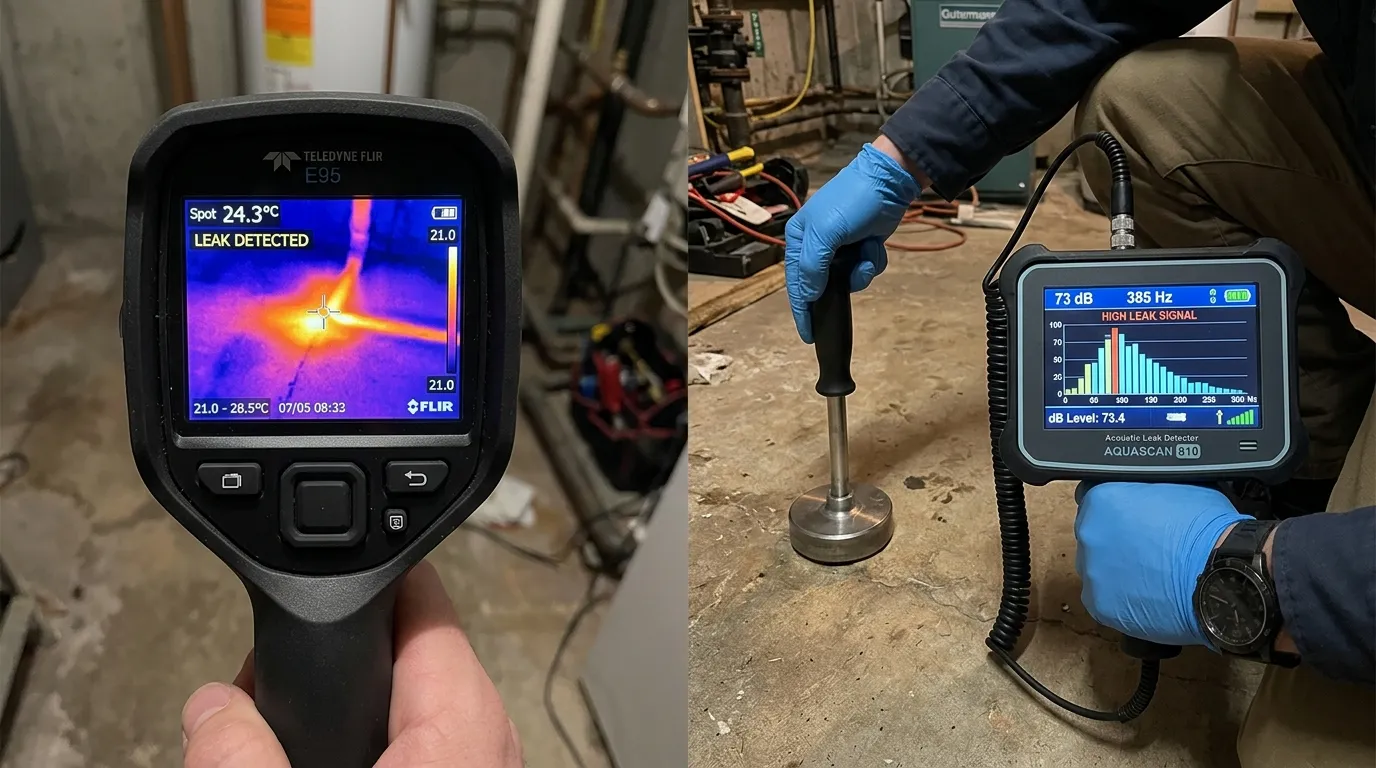
A thermal camera displays temperature differences at the surface. A hot-water line may create a warm path through concrete and tile, while evaporation can sometimes cool a wet surface.
Sunlight, ducts, appliances, cabinets, floor thickness, and recent water use can create similar patterns. The image does not display the pipe itself.
What Acoustic Equipment Hears
Water escaping under pressure can create vibration that travels through pipe, soil, concrete, and finishes. Sensors help compare sound intensity along a suspected route.
Low pressure, small leaks, deep lines, plastic materials, soft soil, and background machinery can weaken or distort the pattern.
| Method | Measures | Best support | Key limitation |
|---|---|---|---|
| Thermal | Surface temperature | Active hot-water loss | Heat has many causes |
| Acoustic | Vibration and sound | Pressurized active leak | Noise and depth interfere |
| Moisture | Material moisture | Damage mapping | Water may travel |
| Pressure test | System stability | Confirming affected system | Does not locate by itself |
Why Providers Combine Methods
If a hot system loses pressure and a thermal path follows the traced line, the evidence is stronger than either result alone. An acoustic peak near the same area adds confidence.
Conflicting evidence should trigger more testing or a qualified limitation—not a more confident claim.
When Thermal Imaging Provides Useful Leak Evidence
Thermal imaging is most informative when an active hot-water system has already shown unexplained flow or repeatable pressure loss. The camera can compare relative surface temperatures and document a path or concentration that changes with heater operation. It is fast, covers a broad area, and can identify patterns that are difficult to feel by hand. It is also useful for choosing where to take closer acoustic or moisture readings.
The camera does not display water or look through concrete. Sun exposure, air ducts, appliances, electrical loads, radiant systems, reflections, flooring materials, and recent water use can create similar patterns. Emissivity and viewing angle affect readings on glossy tile. A useful inspection records room conditions and compares the thermal image with the traced pipe route and isolated hot-system result rather than treating color alone as proof.
For a useful comparison, keep blinds, HVAC settings, appliances, and recent hot-water use documented before scanning. The technician may revisit the same floor after isolating the hot system or allowing temperatures to change. A pattern that responds predictably to plumbing conditions is more persuasive than a single colorful image captured without a baseline.
When Acoustic Detection Provides Useful Leak Evidence
Acoustic sensors are most useful when a pressurized line is actively losing water and the building is quiet enough for comparison. The technician listens at a series of points along the estimated route, changes filters or sensor types, and looks for a repeatable sound signature rather than simply selecting the loudest spot. Metal pipe, adequate pressure, and firm contact paths often transmit a stronger signal.
Small flow, low pressure, plastic pipe, soft soil, deep burial, thick finishes, pumps, traffic, and pipe contact with the structure can weaken or move the apparent sound. The strongest response may occur at a fitting or where vibration transfers into concrete. Combining acoustic results with pressure loss, tracing, thermal patterns, moisture mapping, and construction knowledge produces a defensible access area and a more realistic explanation of uncertainty.
- Thermal tools compare surface temperature, not underground images.
- Acoustic tools compare vibration, not pipe condition.
- Both methods work best after system confirmation.
- Overlapping evidence is stronger than one dramatic reading.
Related Reading and Services
Use these supporting resources to move from the current question to the next useful diagnostic or repair decision.
- Interpret a warm-floor patternCompare hot-line evidence with sunlight, ductwork, appliances, and other non-leak heat sources.
- Review electronic detection capabilitiesUnderstand tracing, pressure, sound, temperature, and moisture measurements as separate tools.
- Confirm the system with pressure testingEstablish repeatable loss before using thermal or acoustic readings to narrow the location.
- Tucson electronic leak detectionReview professional locating methods and what to expect from a documented inspection.
Frequently Asked Questions
Is thermal imaging better for cold leaks?
Cold water may create a subtle temperature difference, but the pattern is often less distinct and strongly affected by ambient conditions.
Can a phone thermal attachment replace professional testing?
It may document temperature variation, but it cannot isolate plumbing, verify pressure loss, or interpret complex construction conditions.
Does the loudest point equal the break?
Not always. Sound can travel along pipe or concrete and may be reflected by cavities and fittings.
Can testing be performed through stone?
It can be attempted, but thickness, density, layers, and heat retention can limit surface evidence.