Key Takeaways
- Different tools measure flow, pressure, sound, heat, route, or moisture.
- A tool result is meaningful only within the tested system.
- Construction conditions change tool performance.
- Converging evidence supports a better access decision.
Each Tool Answers a Different Question
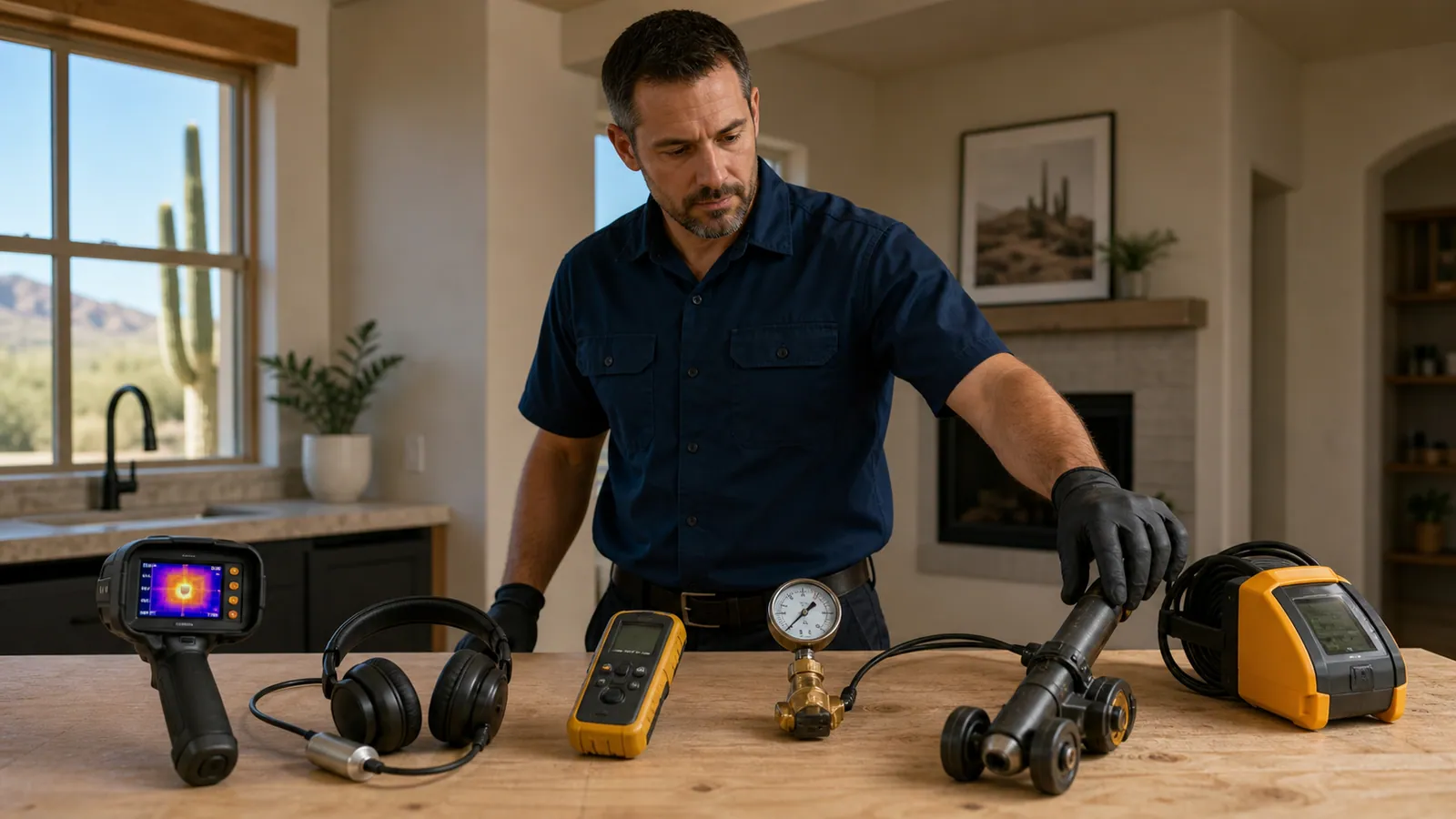
The meter shows whether water passed through the utility meter. A pressure gauge shows whether an isolated section held. Tracing estimates route. Acoustic equipment compares sound. Thermal and moisture tools map surface effects.
Using a thermal camera before confirming hot-system loss may produce an attractive but irrelevant image.
| Question | Useful method |
|---|---|
| Is water flowing? | Meter observation |
| Which system loses pressure? | Isolation and pressure test |
| Where might the pipe run? | Plans and line tracing |
| Where is evidence strongest? | Acoustic, thermal and moisture comparison |
Property Conditions Change Performance
Stone, carpet, wood, cabinets, additions, pipe depth, soil, ambient temperature, pumps, traffic, and HVAC can help or hinder different methods.
A provider should choose tools after learning the construction and plumbing layout, not use the same scan sequence as a sales demonstration.
How Evidence Builds Confidence
Confidence improves when the isolated system loses pressure, the traced route crosses the symptom, and two independent locating methods agree.
If results do not agree, the next step may be monitoring, another test, or carefully planned access—not an exaggerated conclusion.
Confirmation Tools and Location Tools Do Different Jobs
A utility meter confirms that water passed through the meter during a controlled period, but it does not distinguish a toilet from an irrigation line or a slab branch. A pressure gauge tests whether a defined section holds, but it does not show where that section failed. These confirmation tools answer whether loss is active and which part of the plumbing deserves more attention.
Tracing, acoustic, thermal, and moisture tools address location. Tracing estimates a route; acoustic sensors compare vibration; thermal cameras compare temperature; moisture meters compare material conditions. None of those readings replaces system confirmation. Starting with a dramatic thermal image or loud sound can lead the investigation toward normal heat, mechanical noise, or moisture from another source. The sequence matters as much as the equipment.
A Reliable Location Comes From Overlapping Evidence
Suppose the hot system repeatedly loses pressure, a traced branch runs toward the kitchen, a narrow thermal path appears along that route, and acoustic response strengthens in the same area. Those independent observations support a focused access plan. If pressure is stable and only a warm tile appears, the thermal pattern should be investigated as heat—not treated as proof of escaping water.
Ask the technician to explain conflicting readings. Moisture may be strongest downhill from the source, sound may transfer to a fitting, and the apparent route may change because of an undocumented remodel. Good diagnostic work tests alternatives and records limitations. The goal is not to use every available gadget; it is to use the smallest appropriate set of methods that answers confirmation, system, route, and location questions with reproducible evidence.
Tool quality cannot replace setup and interpretation. Calibration, sensor contact, valve isolation, test duration, and the technician’s understanding of building construction all affect the result. Ask for repeatable observations and a written explanation of why the evidence points to one system and area. A longer equipment list is not a substitute for a coherent test sequence.
- Meter: confirms controlled flow.
- Pressure test: identifies the losing system.
- Tracing: estimates the concealed route.
- Acoustic, thermal, and moisture methods: compare location evidence.
Related Reading and Services
Use these supporting resources to move from the current question to the next useful diagnostic or repair decision.
- Review what each electronic tool can measureUnderstand the practical limitations of gauges, tracers, acoustic sensors, thermal cameras, and moisture meters.
- Compare heat and sound evidenceLearn when each method is useful and why the strongest reading is not automatically the break.
- Require the evidence chain in writingUse recorded conditions, repeated results, marked routes, limitations, and confidence language.
- Tucson electronic leak detectionReview a service process that combines confirmation and locating rather than relying on one device.
Frequently Asked Questions
Does more equipment always mean a better inspection?
No. Appropriate setup, isolation, interpretation, and documentation matter more than the number of devices.
Can one tool be enough in a simple case?
A strong clear result may narrow a case quickly, but it should still be supported by basic confirmation of water loss and system identity.
Why might two tools disagree?
They measure different effects and are influenced by different construction and operating conditions.
What should the homeowner ask?
Ask what each result measures, how the affected system was confirmed, what limitations apply, and how the access point was chosen.